Pro Tips
Choosing a Bare Metal Server Provider for Your Solana RPC infrastructure

Rackdog Team
RPC nodes connect applications to the Solana network. They manage requests from wallets, dApps, trading systems, indexers, and analytics platforms. When that layer slows down, falls behind, or becomes unreliable, users feel it quickly.
Because of this, bare metal is widely considered the best option for production RPC workloads. Dedicated servers offer teams better performance and more control. As an added benefit, they often provide more sustainable, predictable infrastructure costs than cloud environments.
But not every bare metal server, nor every provider, is an equal fit for Solana RPC.
If you’re choosing the infrastructure behind a Solana RPC deployment, you need confidence that the provider can support the workload not just on day one, but as traffic grows and demands increase. That calls for thorough evaluation before you commit.
This guide is a helpful breakdown for teams choosing a bare metal server for Solana RPC infrastructure. It highlights key criteria to help you find a reliable partner capable of providing the infrastructure your nodes count on.
Why is bare metal used for Solana RPC infrastructure?
Solana RPC workloads are sensitive to performance variability. Nodes need to stay in sync with the network. At the same time, they manage a steady flow of requests from apps, users, and internal systems.
In shared or virtualized environments, like virtual machines (VMs) or virtual private servers (VPS), CPU scheduling, disk I/O, and network performance can fluctuate when there's heavy load.
Bare metal servers, on the other hand, are single-tenant. All of the underlying resources on your machine are yours and yours alone.
That translates to reliable access to compute and network resources critical for RPC workloads. For production deployments, this consistency is often the biggest reason to run RPC nodes on dedicated bare metal servers.
How to choose a bare metal server provider?
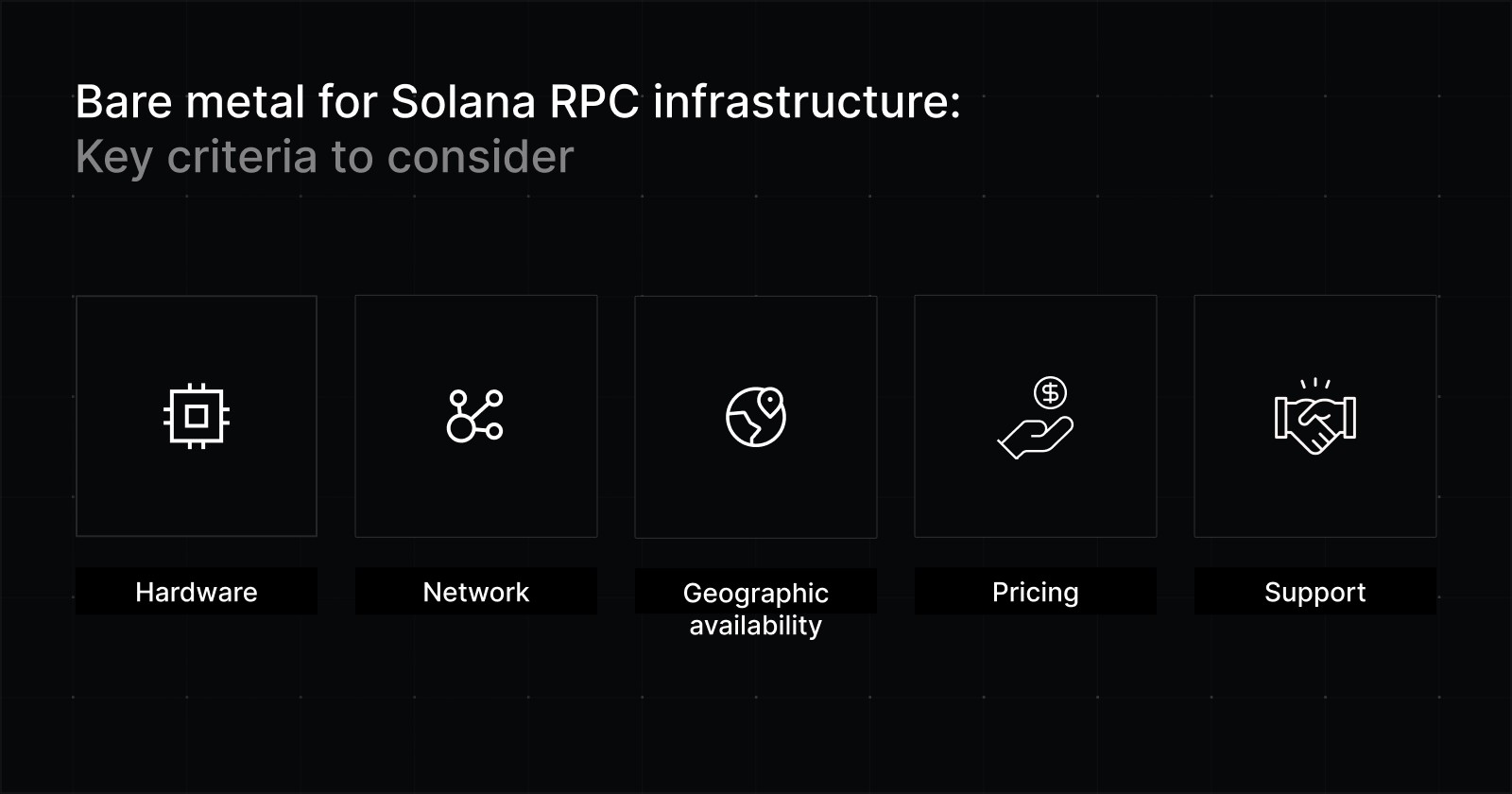
Choosing the best bare metal server for Solana RPC infrastructure means getting two things right: the server itself, of course, and also the provider behind it.
Both need to be a fit for your workload. Otherwise, you can end up dealing with performance constraints, operational friction, or being forced into another migration sooner than you’d like.
Here are the key areas to assess before you commit.
1. Hardware: Getting the specs that match your RPC node's needs
Solana RPC is a two-sided workload: the node has to stay current with the network and serve users at the same time. If the hardware cannot support both, the endpoint becomes slow, stale, or unreliable.
Make sure your bare metal provider has servers that fit your RPC workload’s needs. Verify that the provider can configure servers with enough CPU, memory, and storage available for your use case.
Anza’s hardware requirements for Solana infrastructure provide a useful baseline. They recommend:
Base clock speed of 2.8GHz or higher
Minimum 16 core / 32 thread CPU
512 GB or more of ECC RAM
Separate NVMe storage disks for accounts and ledger; minimum 1TB each
For larger or more complex RPC deployments, those baselines may not be enough. Higher traffic, more account indexes, longer retention, WebSocket subscriptions, and additional data layers can all increase the hardware required to keep the node reliable under load.
CPU
CPU performance impacts how efficiently the node processes requests. It also determines how well the node keeps up with the network while managing multiple requests under load.
A provider should offer high-performance processors with enough cores and threads to handle continuous RPC traffic. However, for Solana RPC nodes, CPU clock speed is often more important than core count for peak performance.
Higher clock speeds help the node process latency-sensitive work faster on each core. Higher core counts help with parallel activity, concurrent requests, and supporting tasks running around the node.
The ideal server is not just “more cores.” Your server should be equipped with a modern, high-clock-speed CPU (Anza specifies 2.8GHz or higher) with enough parallel capacity to support sustained RPC demand.
RAM
RAM matters because it keeps frequently accessed account data and indexes available without forcing the node to rely too heavily on disk.
Memory requirements depend on what the RPC node is expected to support. A simpler private RPC node may need less memory. A provider-grade deployment serving high-volume traffic, account indexes, subscriptions, or additional data services may need far more.
Make sure your provider can support large ECC RAM configurations per node, with room to grow if you anticipate traffic, indexing, and query complexity increasing.
Storage
Storage requirements scale with both data needs and I/O pressure. At a basic level, an RPC node needs fast storage for accounts, ledger data, snapshots, and the operating system.
More advanced deployments might need additional space for:
Retained history
Indexes
Cache layers
Logs
Other data services around the node
Local NVMe is a must, but capacity isn’t the only thing to consider. Layout matters too. Multiple fast NVMe drives can provide better parallel read/write performance than a single large disk, which helps the node handle heavier workloads without creating storage bottlenecks.
A bare metal server provider should support the drive count, capacity, and layout that your RPC deployment needs.
2. Network: Ensuring quick and reliable traffic movement
For Solana RPC infrastructure, fast and reliable networking is essential to the user experience.
The node needs steady connectivity to the Solana network while also serving requests. When traffic becomes inconsistent, RPC performance suffers. The symptoms can include stale reads, delayed responses, failed requests, or unreliable transaction submission.
That makes it important to look beyond advertised port speed. A 10Gbps or 100Gbps port doesn’t guarantee a provider can deliver consistent throughput under load. The quality of the provider’s network, including its routing, carrier connectivity, and peering, determines whether traffic moves quickly and reliably enough.
When evaluating providers, ask what carriers they use, whether they have redundant upstream connectivity, how they handle congestion or route changes, and whether higher port speeds are available in the regions you plan to use.
3. Geographic availability: Maximizing performance with locations closer to users
When it comes to optimizing latency, you can’t beat physics. Even with the right hardware and strong network performance, distance between your node and users or applications still affects response times.
Placing nodes closer to users, applications, and high-demand markets can reduce latency and improve reliability.
Regional availability also gives RPC operators more flexibility. Multiple locations can support redundancy, failover, and expansion as traffic grows or demand shifts.
When evaluating providers, check if they have data center locations that fit your current deployment needs and options that give you room to grow without changing infrastructure partners.
4. Pricing: Making sure costs scale predictably
Predictable infrastructure costs are crucial for RPC operators, especially as traffic volume grows. If you aren’t able to forecast what it costs to operate a node (including not just the cost of the server, but also bandwidth and any applicable fees, add-ons, overages, etc), growth can quickly turn into a billing problem.
Bandwidth deserves particular attention. Some providers offer unmetered dedicated servers with outbound bandwidth in the cost of the server, while others meter usage after a set threshold. RPC workloads can move a lot of data, so metered egress can make costs harder to forecast and harder to control as traffic grows.
When evaluating providers, look for clear server pricing, transparent costs for add-ons and upgrades, and a bandwidth model you’re comfortable planning around as you add nodes, regions, and traffic.
5. Support: Having a reliable partner you can trust
When choosing a bare metal provider for your Solana RPC infrastructure, the quality of the partnership and level of support you can expect matters just as much as the servers you deploy. It’s worth evaluating that relationship before you commit.
Ask about:
Incident response: How fast can you contact a technical person when hardware, routing, or performance problems arise?
Remote recovery: Do you get IPMI/KVM access, reinstall options, and enough control to recover a node quickly?
Capacity expansion: Can the provider help you add servers quickly when traffic grows or a new region becomes necessary?
Web3 infrastructure fit: Are they comfortable supporting blockchain workloads? Will your deployment create policy or support friction later on?
A provider’s website can tell you the basics, but direct engagement usually gives you a clearer picture. Watch how they answer technical questions. Notice their response speed. Do they seem ready to support a serious RPC deployment?
Who is the best bare metal provider for Solana RPC infrastructure?
Choosing the best bare metal provider for your Solana RPC infrastructure means finding a partner capable of delivering:
High-performance servers with high-clock modern CPUs, ECC RAM, and local NVMe storage
Strong network capacity
Predictable costs and sustainable bandwidth pricing model
Advantageous locations and region coverage
Fast, attentive support from real engineers and infrastructure experts
Considering those criteria, Rackdog is a strong fit for Solana RPC workloads, supporting every stage and scale, from private RPC nodes to multi-region deployments.
Rackdog offers dedicated, high-performance bare metal servers with clear monthly pricing and no egress fees. 10Gbps uplinks come standard, with the option to upgrade port speeds as needed. Rackdog’s bare metal servers for blockchain workloads feature local NVMe storage, IPMI/KVM access, and support for API and Terraform.
Thinking about bare metal for Solana RPC nodes? Get in touch with our team of experts. We can help you determine the right specs, locations, network needs, and deployment model for your workload.
FAQs
Do Solana RPC nodes need bare metal?
Production Solana RPC workloads are often best suited for bare metal. Bare metal servers offer reliable access to underlying CPU, memory, storage, and network resources. These factors are essential for optimal performance. Shared or virtualized environments, like cloud virtual machines (VMs) or virtual private servers (VPS), can introduce variability that affects performance under load.
What specs do Solana RPC nodes need?
Requirements vary by traffic, indexing, and retention. As a baseline, Anza recommends 16 cores / 32 threads or more for RPC nodes, 512GB RAM or more when running all account indexes, and NVMe storage for accounts, ledger, and snapshots.
What is the difference between a Solana validator and an RPC node?
A validator helps secure the Solana network by participating in consensus. An RPC node serves applications by returning blockchain data, supporting subscriptions, and submitting transactions.
What should I look for in a bare metal provider for Solana RPC?
Look for strong CPU options, large ECC RAM configurations, local NVMe storage, reliable networking, predictable bandwidth pricing, useful region coverage, remote access, and responsive technical support. For larger deployments, make sure the provider can support multi-server and multi-region growth.