Pro Tips
Bare Metal as a Service (BMaaS): Moving Beyond Public Cloud

Rackdog Team
Cloud computing solved a real problem. Before it, running infrastructure meant owning hardware: sourcing servers, managing networks, and staffing the expertise to keep it running.
The cloud removed that burden and let small teams run systems that once required dedicated operations staff.
But as workloads grow, cloud inefficiencies become harder to ignore. Usage-based pricing and egress fees drive infrastructure costs upward, while shared infrastructure introduces performance constraints that can’t be engineered away.
When teams look for alternatives, the conversation often stalls. For many engineers, the only reference point for non-cloud infrastructure is the on-premise era they were relieved to leave behind.
That assumption is outdated.
Today, Bare Metal as a Service (BMaas), is an option for teams that want to run workloads on dedicated physical servers without procuring hardware, managing facilities, or taking on the operational burden that made on-prem difficult in the first place.
Why teams are reconsidering public cloud
A recent industry survey found that 87% of qualified IT decision-makers expect to pursue some form of cloud repatriation within the next two years.
Two problems are driving the push to move workloads out of the cloud:
Cloud pricing stops making sense as workloads stabilize
Major cloud providers like AWS, GCP, and Azure charge based on usage. You pay for the compute, storage, and bandwidth your services consume, and costs drop when those resources aren’t being used.
That model works well when demand is unpredictable. Teams avoid committing to capacity they may not need, and infrastructure costs scale naturally during early growth. But most systems eventually stabilize. Databases, API backends, queues, and background workers settle into steady utilization. At that point, those services start paying a premium for flexibility they rarely use.
Egress fees only makes the problem worse. Every gigabyte leaving a cloud provider’s network is billed, at rates as high as $0.09/GB or more. For high-traffic services pushing petabytes of egress, that line item alone can reach six figures monthly.
Virtualization and shared infrastructure introduce performance variability
Public cloud instances run on physical servers divided into virtual machines by a hypervisor. That virtualization layer introduces some overhead (CPU scheduling, memory virtualization, and network or storage abstraction) that eats resources, which means workloads don’t always get the full performance implied by the underlying hardware.
The hardware is also shared across tenants. This means a neighboring workload placing heavy demand on CPU, storage, or network resources can affect your response times. This is known as the noisy neighbor effect, and often shows up as tail latency spikes that impact reliability and frustrate users.
What stops them from acting?
When cost and performance concerns arise, the case for moving certain workloads off the cloud is often clear on paper. What stops teams from committing to repatriation is a mental model inherited from the pre-cloud era.
When dedicated infrastructure comes up, teams sometimes associate it with on-premises (on-prem) operations: hardware procurement, physical network configuration, and specialized staff to maintain it. For teams that are built entirely in the cloud, those capabilities may not exist internally and aren’t something they want to dedicate time to developing.
Colocation is one alternative — renting rack space in a third-party data center while still owning and managing the servers. But even this option can introduce capital investment and operational risk that many teams prefer to avoid.
So the conversation ends there. Teams keep optimizing within the cloud, squeezing incremental savings from reserved instances and right-sizing exercises until the next cycle of the same discussion.
What teams like this miss is that getting the benefits of dedicated servers doesn’t have to mean managing hardware.
The case for Bare Metal as a Service (BMaaS)
Bare Metal as a Service (BMaaS) is an infrastructure model that lets you run workloads on dedicated physical servers without owning the hardware or taking on the risk that comes with it.
You rent bare metal servers (meaning physical servers without a virtualization layer) on demand, for as long as you need them, without having to ever touch the physical machine.
Unlike traditional on-prem setups, you don’t have to manage the physical server. The provider owns and maintains the hardware, while you typically control the operating system and everything running on it.
Unlike colocation, the provider also procures and racks the servers in the data center for you, handling hardware maintenance without you needing to send someone onsite or rely on remote hands.
And unlike cloud, those servers aren’t shared with other customers.
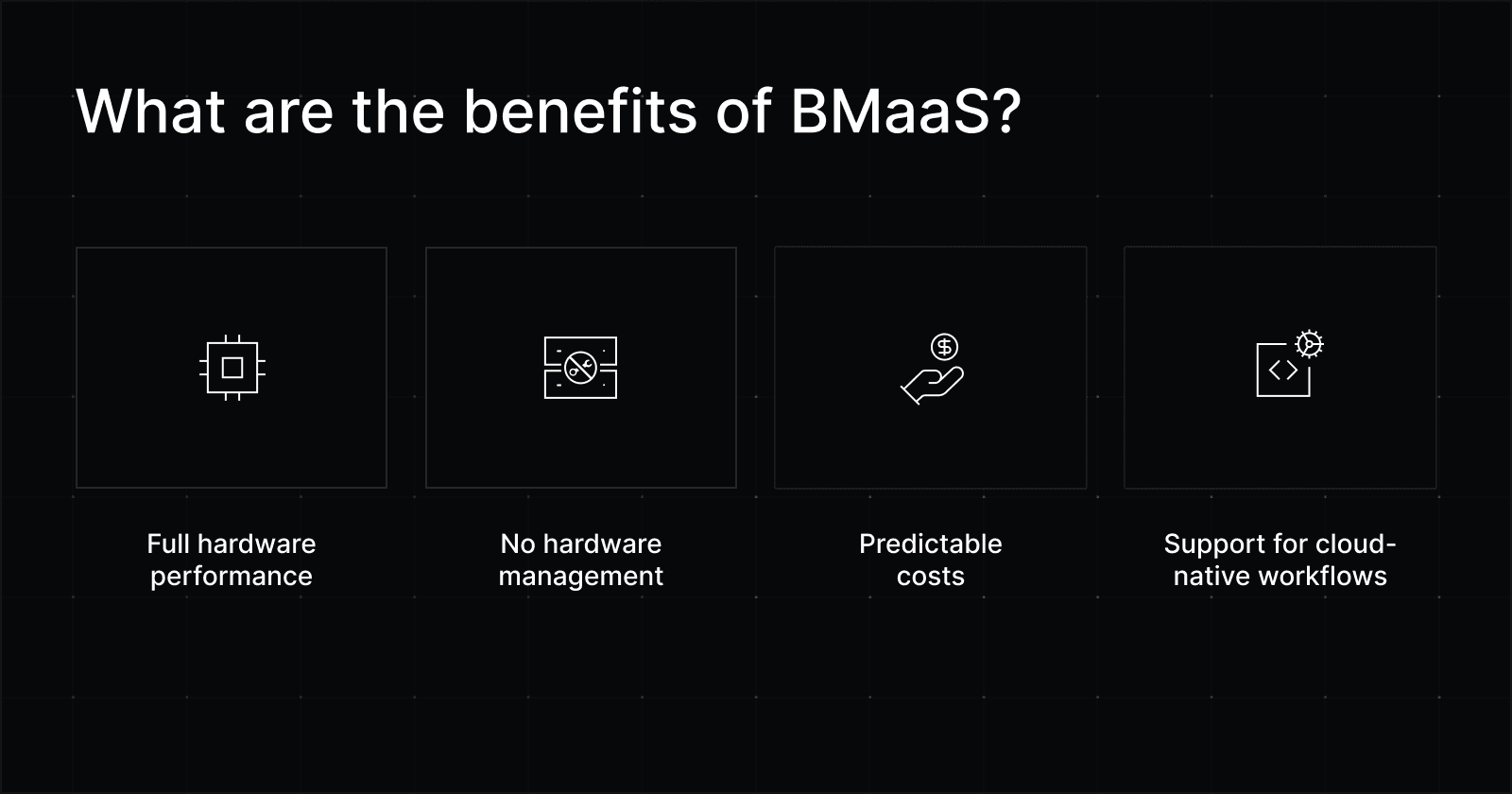
BMaaS comes with significant benefits, combining the power of dedicated servers with the operational ease of running in the cloud:
Full hardware performance, without hardware ownership
Without a hypervisor between the workload and the machine (unless you choose to add one yourself), bare metal delivers the full performance of the underlying hardware.
There’s no hypervisor scheduling overhead, no memory ballooning, and no virtualized I/O layer in the path. And because you’re the only tenant on the server, there are no noisy neighbors competing for CPU, memory, or disk.
For latency-sensitive systems, that level of performance predictability alone can justify the move.
Predictable cost that scales with you
Pricing varies by BMaaS provider, but customers can usually expect to be billed a monthly fee for each server, with egress either unmetered or available for much cheaper than what hyperscalers charge.
That means your infrastructure bill doesn’t rise every time traffic or usage increases. For high-traffic services, separating infrastructure cost from product usage prevents costs from growing faster than revenue.
Cloud-native workflows make managing servers easy
Modern BMaaS platforms are built for teams that manage infrastructure through code. APIs, Terraform providers, and other infrastructure-as-code tools are commonly supported, allowing servers to be provisioned and managed programmatically.
For teams already operating in the cloud, the workflow feels familiar: infrastructure is defined in code, deployments are automated, and systems can be managed through tooling rather than manual configuration.
The management layer is also simpler. Consoles from providers like AWS, Azure, and GCP have grown to support thousands of configuration options across dozens of services. BMaaS platforms typically expose a much smaller, more focused set of controls.
FAQs about Bare Metal as a Service (BMaaS)
For teams that are more familiar with cloud or on-prem infrastructure, BMaaS can raise a few practical questions. Here are some of the most common:
“How fast can we provision new servers?”
For in-stock configurations, provisioning typically completes in minutes. That compares favorably with colocation or self-managed data centers, where hardware lead times are measured in days or weeks.
“Our team has no experience running servers. Will this work?”
The hardware layer is fully managed by the provider. That’s the part of managing infrastructure that historically required specialized expertise.
What remains in scope for your team is OS and software management: deploying workloads, managing configuration, and maintaining the software environment. For teams already operating production services in the cloud, these are likely existing or easily attainable competencies.
“What happens when something goes wrong at the hardware level?”
Hardware failures (drives, NICs, or other components) are the provider’s responsibility to diagnose and resolve within SLA windows. Your team continues owning the software layer, just as it does in the cloud.
This is worth verifying during provider evaluation. “Managed hardware” can mean different things: some providers include OS-level support and monitoring, while others only replace failed components.
“Is our traffic too variable to commit to fixed capacity?”
For workloads with truly unpredictable demand, cloud elasticity still earns its cost. The ability to scale capacity up and down quickly is valuable when traffic patterns are hard to forecast.
But that description rarely applies to an entire system throughout a company's growth.
Most mature architectures have a stable core, databases, API backends, and core services that run at fairly predictable baseline load, alongside components that fluctuate with demand.
That stable core is often the best candidate for dedicated infrastructure, where predictable cost and consistent performance matter most. Variable workloads often benefit from remaining in the cloud.
This approach of separating workloads and running them where they fit best is known as hybrid infrastructure, and it’s a very common way teams implement their cloud repatriation plans.
Final takeaways
Operating outside the cloud used to require the time and resources to manage physical hardware, whether in your own server room or collocated in a third-party data center.
That’s no longer the case, as BMaaS has emerged as a viable option for teams looking for performance, predictable cost, and control of dedicated infrastructure without the headaches of managing it.
If you're evaluating a move off of the cloud, our team can help assess your needs and plan a smart migration to dedicated infrastructure that’s easy to provision and manage.
Rackdog provides dedicated bare metal servers deployable in minutes from data centers worldwide. Choose from available servers, or meet with us to design a custom solution suited to your needs.